
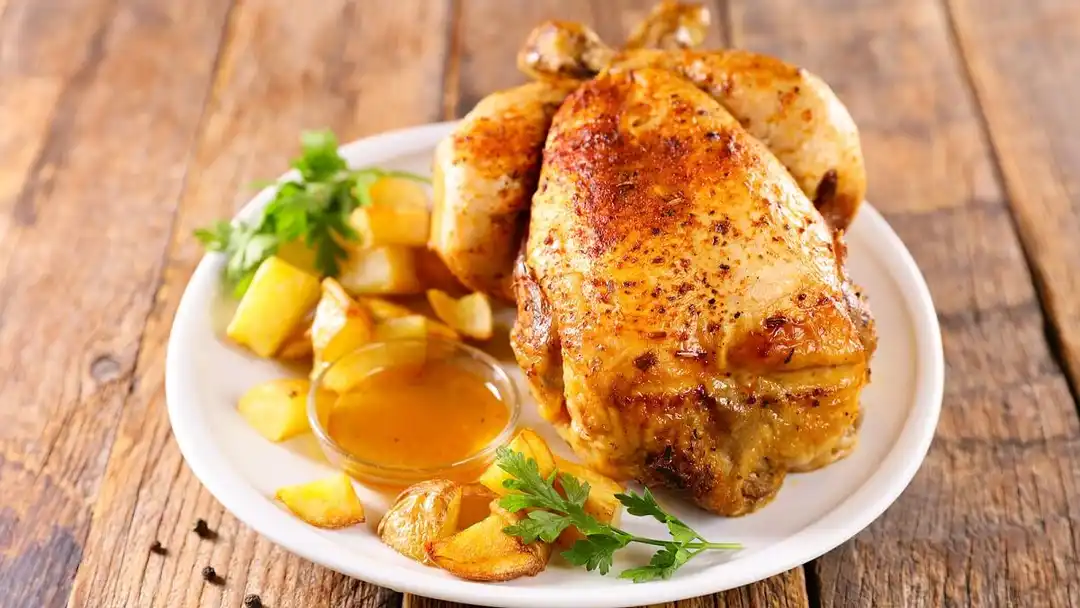
In industrial poultry farming, when we talk about chicken for meat – in poultry jargon, «broiler»(1) – we mean a type of bird, of both sexes, whose main characteristics are its rapid growth rate and the formation of notable muscle masses, mainly in the breast and legs, which gives it a rounded appearance, very different from that of other breeds or crosses of the same species, raised for egg-laying.
The short growth and fattening period of the broiler, about 6 or 7 weeks – has made it the main basis for the mass production of everyday poultry meat. This is therefore the main focus of this presentation.
The popularisation of the broiler as mass-consumption poultry meat is due to well-defined reasons:
-It is a meat that provides efficient and nutritious proteins
- Suitable for all ages,
- It is easy to prepare,
- It has no religious contraindications.
(1) A "broiler" is understood to be a young bird resulting from a cross
Genetically selected to achieve a high growth rate.
Apart from this, having the necessary infrastructure for the development of the chicken farming sector is much faster than in the case of any other meat production.
This is what has led to it being encouraged by all governments which, moreover, have seen it with interest because, due to its low production cost, chicken meat is a deflationary item.
On the other hand, chicken meat has some drawbacks that have curbed its consumption, in some cases, when a very high level of consumption has been reached, such as the following:
- the fact that chicken is a cheap meat compared to others, leading to weariness from its repetition,
- the bad press it has received, which has given rise to the false popular opinion that "industrial" chickens are fed with hormones, chemicals, antibiotics, etc.
- the popular opinion, also based on this, that current chickens are worse than those of the past – older birds with a more "cooked" meat –,
- the social consideration that current chicken is a "low-class" product to offer to guests.
This has meant that, in general, while in developing countries broiler farming has been promoted, consequently increasing consumption very rapidly, in developed countries it is either stagnant or growing very slowly, to which the natural desire to diversify food choices also contributes.
The Spanish broiler sector has undergone development over the last half-century similar to that of the most developed countries, albeit with a serious drawback: its external dependence. This is the case regarding genetics, as Spain has no breeding farms, for feed, as a large part of the cereals and almost all of the soya and other protein sources must be imported, and even in the pharmaceutical sector, due to the need for additives and pharmacological products necessary for the successful rearing of chickens.
To conclude this historical review, we will say that in recent years the main driver of the advances that have taken place in the sector has continued to be genetics, without ruling out the role played by feed, through the formulation of increasingly well-balanced rations, or the improvement of facilities, which today provide chickens with infinitely better rearing conditions than they had just half a century ago.
The challenges facing the poultry industry are as follows:
l Achieving animal welfare objectives
l Availability of Raw Materials for broiler feed.
l Search for New Market Segments, with the design of new products.
To this end, the objectives of the poultry industry must be:
l Effective increase in chicken production
l Optimise raw material sources
l Respond to consumer requirements.
l Identify and develop new markets
l Introduce value-added products
l Stability of margins
l Improvement of Quality
Why Chicken?
The chemical composition of chicken is, obviously, the basic starting point in determining its nutritional value.
· A first approach leads to the establishment of the so-called centesimal composition (% water, protein, lipids, carbohydrates, and ash).
· A second level of knowledge requires data on qualitative composition for each group of nutrients (available carbohydrates, essential amino acids, fatty acids, vitamins, and mineral elements).
Finally, a last level of information could be considered, which takes into account the chemical species present in the food, which is often fundamental for establishing the real nutritional value.
A second aspect to consider is Availability:
· Digestibility or the ratio between the amount absorbed and the amount ingested
· Bioavailability; Nutrients may be present in the chicken but in such a way that they cannot be totally or partially absorbed and/or utilised by the human body, i.e., they are not available.
Comparatively with other products, chicken, has exceptional qualities as described in the following tables, being a source of high-quality protein, low in fat, high in unsaturated fatty acids and a source of vitamins, among others. Consequently, it makes it a product of high nutritional quality and healthy.