
SWOT(Weaknesses, Threats, Strengths and Opportunities) or SWOT in English (Strengths, Weakness, Oportunities and Tretas)
The SWOT analysis has become very important in strategic business management.
Its objective is to specify, in a summary graph or table, the evaluation of the company's strengths and weaknesses (competence or capacity to generate and sustain its competitive advantages) with external threats and opportunities, in line with the logic that strategy must achieve an adequate fit between its internal capabilities and its external competitive position.
The important thing is to think about what needs to be sought to identify and measure the company's strengths and weaknesses, opportunities and threats, key issues that are gathered in a table.
Internal strengths and weaknesses are important as they can help us understand our company's competitive position in a specific business environment. A first step, therefore, is to analyse the competitive environment surrounding our company. Each company must decide which variables (critical success factors –CSFs-) are appropriate to use according to the markets and segments in which it competes.
Once the CSFs have been defined, a process of benchmarking or comparative analysis with the best competing companies must be carried out. This process may even lead us to identify new opportunities.
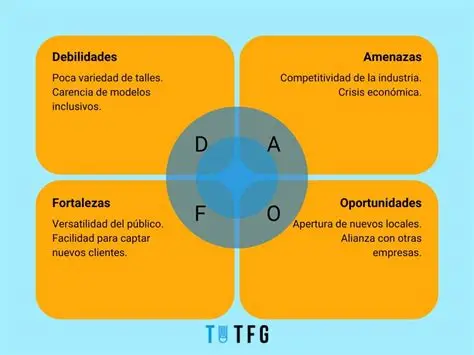
Finally, a graph is established to capture the possible strategies to adopt. This graph is created from the development of a 2 x 2 matrix that captures the formulation of these most convenient strategies.
In this SWOT matrix, the columns will establish theenvironmental analysis(1st column: Threats, 2nd column: Opportunities) and the rows will establish thecompany diagnosis(1st row: Strengths, 2nd row: Weaknesses). This establishes 4 quadrants that reflect the possible strategies to be adopted by the company:
1-1….. Defensive strategies
1-2…… Offensive strategies
2-1…… Survival strategies
2-2…… Reorientation strategies
|
SWOT Matrix
|
THREATS
|
OPPORTUNITIES
|
|
STRENGTHS
|
Strategies
defensive
|
Strategies
offensive
|
|
WEAKNESSES
|
Strategies
survival
|
Strategies
reorientation
|
The practical development of the matrix is completed by analysing each quadrant in isolation. That is, if the first is chosen (1-1…Strengths-Threats), each of the strengths that the company in question has and each of the external threats it faces must be identified, so that each intersection must be analysed to study the consequences and the actions that may arise from such a situation. With this information, the future formulation of the strategy can be guided.
1-1….. Defensive strategies: the company is prepared to face threats.
1-2….. Offensive strategies: this is the position in which every company would like to be. It must adopt growth strategies…
2-1….. Survival strategies: the company faces external threats without the necessary internal strengths to fight competition.
2-2….. Reorientation strategies: the company is presented with opportunities it can take advantage of, but it lacks adequate preparation. The company must establish a programme of specific actions and reorient its previous strategies.
With this tool, the diagnosis must be carried out, as we have indicated previously, taking into account the peculiarities of the activity and economic information of each sector.
Examples of STRENGTHS:
o Capabilities in key activities.
o Adequate financial resources.
o Superior technological skills and resources.
o Ownership of core technology.
o Cost advantages.
o Significant R&D programme.
o Good consumer image.
o Market leader.
o Management capability.
o etc.
Examples of WEAKNESSES:
o No clear strategic direction.
o Inability to finance necessary strategic changes.
o Lagging R&D.
o Below-average profitability.
o Weak market image.
o Limited product portfolio.
o Obsolete facilities.
o Weak distribution network.
o Inefficient systems (excess of internal operational problems).
o etc.
Examples of OPPORTUNITIES:
o Entering new markets or segments.
o Serving additional customer groups.
o Expanding the product portfolio to meet new customer needs.
o Rapid market growth.
o Diversification of related products.
o Removal of trade barriers in attractive foreign markets.
o etc.
Examples of THREATS:
o Entry of new competitors with lower costs.
o Increase in sales of substitute products.
o Slow market growth.
o Change in consumer needs and tastes.
o Increase in costly regulatory barriers and requirements.
o Growing bargaining power of customers and/or suppliers.
o etc.
|
SWOT Matrix
|
THREATS
|
OPPORTUNITIES
|
|
POINTS
STRENGTHS
|
Defensive strategies: |
Strategies offensive:
|
|
POINTS
WEAKNESSES
|
Survival strategies: |
Retrenchment strategies: |